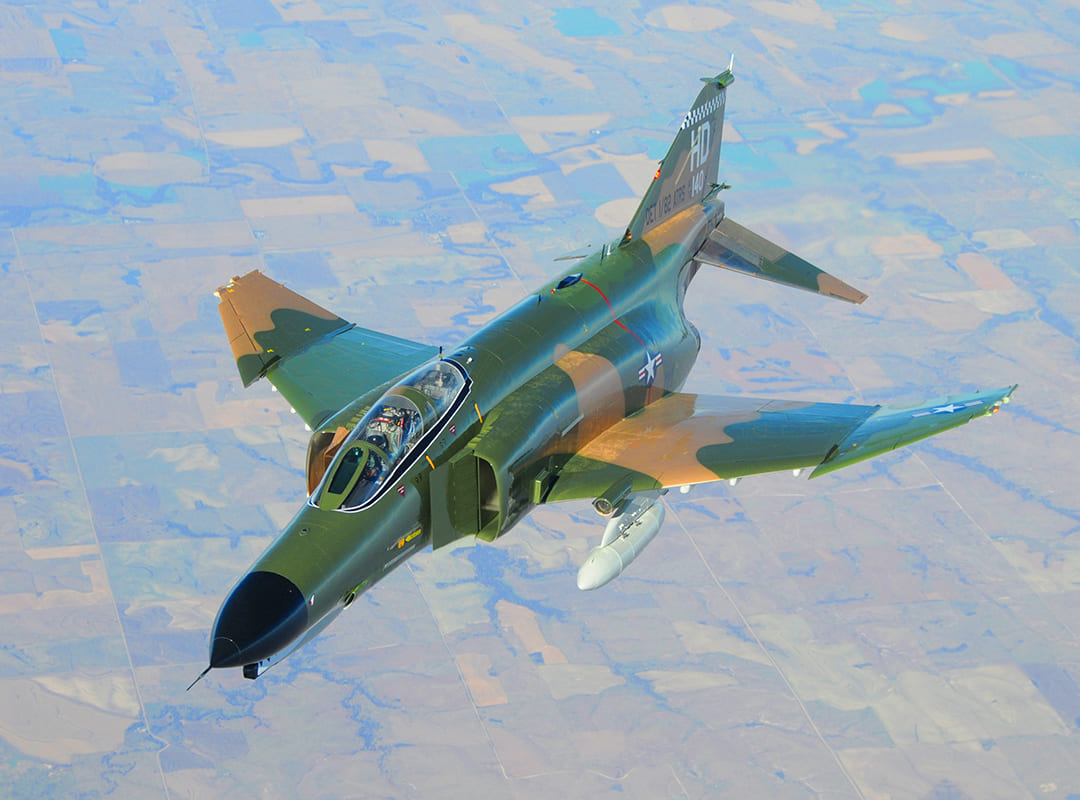

F-4 Phantom II
July 17-19, 2026 | Willow Run Airport | Ypsilanti, MI
HISTORY
The McDonnell Douglas F-4 Phantom II is the most significant fighter aircraft of the 20th Century. First flown on May 27, 1958, the Phantom II entered service with the Navy, Marine Corps and Air Force. The Air Force’s initial version was the F-4C which first flew in 1963. For the most part, this article will focus on the versions operated by the Air Force, Air National Guard and Air Force Reserves.
The F-4 has two cockpits in tandem for a pilot in the front seat and radar/navigator or weapon system officer in the back. The highly-swept, low-wing design has dihedral outer wing panels (up-turned) offset by horizontal stabilizers with an anhedral (down-turned) angle. The jet sits on tricycle landing gear and has large air intakes for the jet engines with air controlled by variable-ramps at the intakes leading edge. For a fighter, the F-4 is a massive, heavy-weight hitter with a maximum take-off weight of 61,795 pounds.
The mach-two plus capable aircraft was originally designed as a Navy carrier-borne fighter/bomber and all version of the Phantom II have a robust tail hook between the engine nozzles, under the tail. The folding outer wing panels suited it well to carrier operations with the Navy and Marine Corps and in revetments with all services when conducting land-based operations during the Vietnam War.
GENERAL CHARACTERISTICS
Rate of Climb: 41,300 ft/min
Service Ceiling: 60,000 ft
Max Speed: Mach 2.2 (1,472 mph)
Max Thrust: 11,870 lbf each (mil) / 17,900 lbf (each afterburner)
Power Plant: J79-GE-15/17 afterburner turbojet
Max Weight: 61,700 lb